
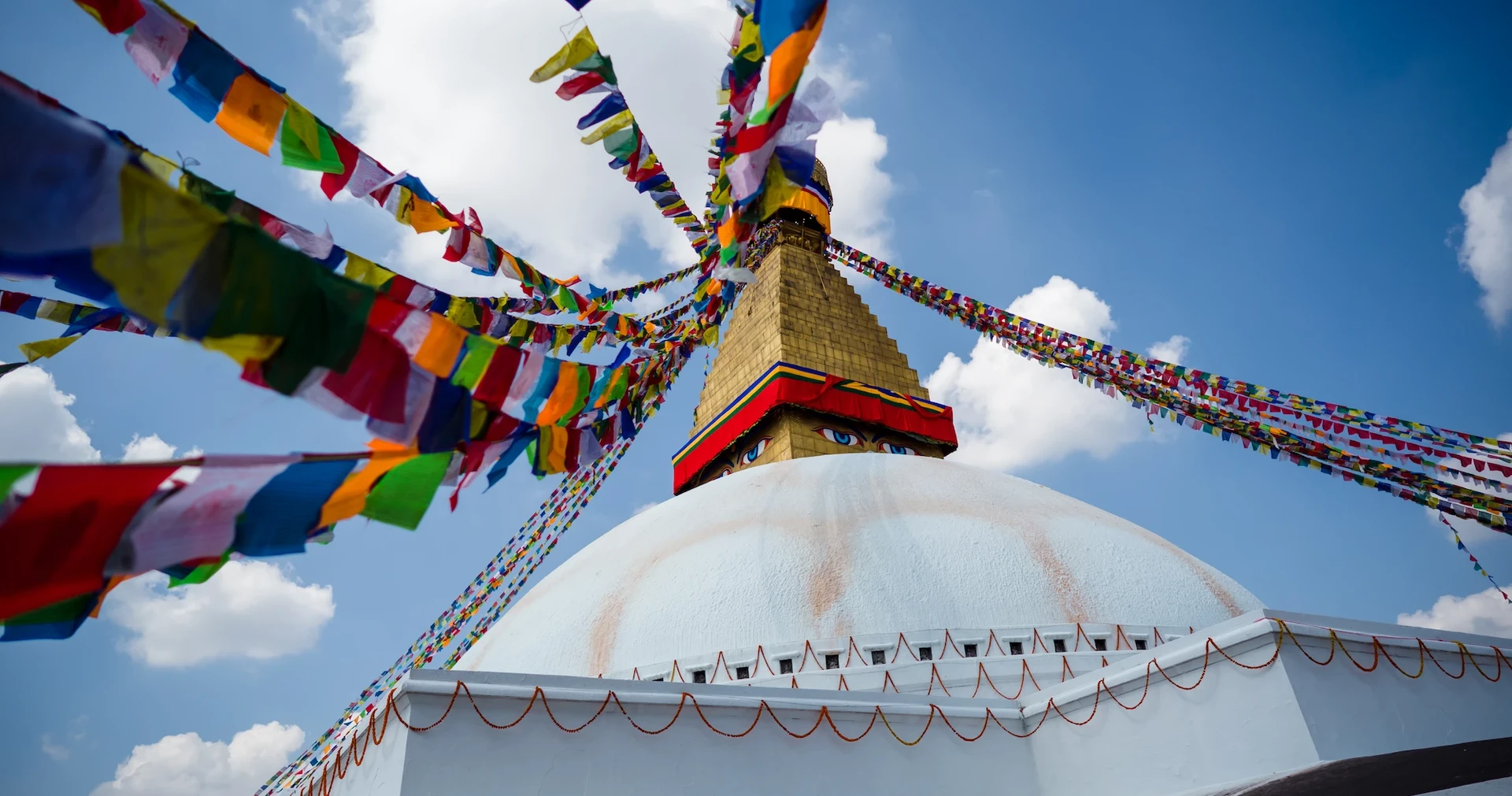

The journey from Lhasa to Kathmandu offers one spectacular travel experience. You'll start with several days exploring Lhasa's historic sites, immersing yourself in the colors and rich culture of Tibetan life. Then comes the highlight many travelers dream about: the journey to Everest Base Camp, where you'll stand before the world's tallest peak.
As you continue toward the Nepal border, the landscape transforms. You'll descend from the stark, high-altitude beauty of Tibet into subtropical valleys approaching Kathmandu. The scenery becomes greener and more tropical with each passing mile. becomes greener and more tropical with each passing mile.


Welcome to Tibet! Our team will greet you at Lhasa Gonggar Airport's arrival hall with a personalized welcome sign. You'll be welcomed with "Tashi Delek" a traditional Tibetan blessing, and presented with a ceremonial white khata scarf, marking the beginning of your Tibetan adventure.
Upon arrival at Lhasa Gonggar airport, our guide and driver will be waiting for you at the exit gate, with your name board. Tashi Delek is probably the first Tibetan word you will hear upon arrival, it is an endearing gesture of welcoming our guest followed by offering a white scarf which is called Khata in Tibetan.
The 70-kilometer ride to Lhasa takes approximately one hour. Along the way, you'll follow the Yarlung River (the upper reaches of the Brahmaputra) and catch your first glimpse of the Potala Palace dominating Lhasa's skyline.
After checking into your hotel, the priority should be to rest and acclimatize. At 3,650 meters above sea level, your body needs time to adjust to the thin air. Take it slow, stay hydrated, and avoid any strenuous activity.

Fuel up with breakfast at your hotel (available from 7:30 am to 10:30 am) before diving into Lhasa's treasures. Your guide come get you you for a 5-minute stroll to Jokhang Temple, one of Tibet's most sacred shrines. This 1,400-year-old temple sits at the very heart of old Lhasa and has served as both Tibet's spiritual epicenter and its historic commercial hub for centuries.
Next, you'll experience the famous Barkhor Street, a pilgrimage circuit that encircles Jokhang Temple. Join the stream of pilgrims as they complete their walk, spinning prayer wheels. The 15-20 minute loop is lined with traditional shops. Watch for pilgrims performing full-body prostrations and admire the costumes worn by Tibetans.
The afternoon brings you to Sera Monastery, one of Tibet's three great monastic universities. If you arrive by 3 pm, you'll witness the renowned monk debates in the monastery courtyard, an animated scholastic tradition where monks test each other's understanding of Buddhist philosophy through dramatic gestures and spirited discussion. Founded in 1419 by Jamchen Choji Sakya Yeshi, a devoted student of the great reformer Tsongkhapa, Sera represents the scholarly tradition of the Gelugkpa school of Tibetan Buddhism.


This day will bring you face-to-face with one of Tibet's very iconic landmarks. The morning ascent to Potala Palace will feel energizing in the crisp mountain air. The palace consists of two main sections: the White Palace, which housed the administrative offices and living quarters of the Dalai Lamas, and the Red Palace, dedicated to religious ceremonies.
This impressive architectural piece has deep roots in Tibetan history. King Songtsan Gampo first built it in the 7th century and it was later expanded by the Great Fifth Dalai Lama in the 17th century. Take your time climbing, the views will become more spectacular with each level, and inside you'll discover cultural treasures that have been preserved for centuries.
After visiting Drepung Monastery (once home to 10,000 monks and considered the largest monastery in the world), you'll experience Tibetan hospitality at a home dinner with our team. Our skilled cook will prepare traditional dishes (flavorful but not overwhelming for international palates). You'll get hands-on experience making yak momos, and the evening will be filled with stories about Tibetan culture, insights into our team's daily life, and opportunities to share your own travel experiences and suggestions.


A early morning departure from Lhasa sets the perfect tone for today's journey. As you leave the city behind, the morning light reveals the Tibetan landscape unfolding ahead of you.
Your first destination is Yamdrok Lake, reached after a 2.5-3 hour drive covering 110 kilometers via the Gambala Pass at 4,790 meters. Known locally as Yamdrok Yumtso, this sacred lake is considered one of Tibet's three holiest bodies of water. Its water stretches for 72 kilometers, creating a stunning contrast with the surrounding snow-capped peaks and blue sky. The road follows the shoreline, offering changing perspectives of this wonder.
Continuing for another hour, you'll reach Karola Glacier, one of Tibet's major continental glaciers. Located on the border of Nagarze County, this ice formation cascades down from the mountain peaks, creating an impressive wall of ice.
Your final stop is Gyantse, where you'll visit the Kumbum Stupa at Pelkor Monastery. Built in 1427 by the Gyantse prince, this architectural marvel translates to "one hundred thousand holy images". The nine-story structure contains 77 individual chapels and represents a unique three-dimensional mandala: it is meant as a physical representation of the Buddhist cosmos that you can walk through and explore.


Morning visit to Tashi Lunpu monastery. Tashi lunpu monastery was founded by the 1st Dalai Lama in 1447, it is traditional monastic seat of successive Panchen Lama. After obtaining Alien’s travel permit (ATP) from the local police security bureau (PSB) The drive is about 2:30hrs until you will stop at Sakya monastery en route to Shegar. Sakya monastery is famous for its 84,000 scrolls of ancient Buddhist scripture sealed in a wall of 60 m long and 10 m high in the library.
Sakya monastery has two parts divided by the Zongchu River. The Northern side of the monastery built by Kon Konchok Gyalpo is not active nowadays and was left in ruins. The southern part of the monastery built by Dromgon Choegyal Phakpa is where most of the rituals and praying happen.


After breakfast, we drive straight to Everest Base Camp (EBC) and Rongbuk Monastery, crossing several high passes along the way. The first is Gyatso La Pass (5,400 m), offering a sweeping panorama of the Himalayas. From the viewpoint, you can see Mt. Makalu (8,463 m), Mt. Lhotse (8,516 m), Mt. Everest (8,848 m), Mt. Cho Oyu (8,201 m), and Mt. Shishapangma (8,020 m) lined up across the horizon.
Upon arriving at Rongbuk Monastery, you will have time to explore the monastery area, home to both monks and nuns and known as the highest monastery in the world (4,980 m) and enjoy spectacular views of the North Face of Mount Everest.
After the visit, we go to the EBC Tent Guesthouse, where we will spend the night. These seasonal tented camps offer a unique experience of sleeping near Everest Base Camp, with views of the peak right outside your door.


Today you'll reach Peikutso Lake, where you can catch a glimpse of Mount Shishapangma in the distance. As you descend further, the landscape will start changing noticeably, more trees will appear, and the grass will become greener. You're getting close to the Kyirong Valley now.


The drive from Kyirong town to the border crossing takes about 30-40 minutes. Your guide will assist you through the customs procedures and help arrange a Nepalese driver for the onward journey to Kathmandu. The 149-kilometer route to Nepal's capital winds through stunning valleys, including sections of Langtang National Park, offering beautiful mountain scenery as you make your way down to Kathmandu.


House of Shambhala hotel is a Tibetan Style boutique in old town of Lhasa. We recommend this beautiful and deep cultured accommodation for those who are seeking an authentic and cultural experience. Since it has limited number of rooms, we prefer to book rooms with them at least one month before the high season.

Tashi Choedar Hotel is located very close to Tashilhunpo Monastery. While the hotel's official name has been changed to Shigayangcha, our guides and drivers still refer to it by its original name. Among the quality hotels in Shigatse, Tashi Choedar stands out for its extensive experience in hospitality and service for international guests. Many staff members speak English and are notably friendly. The rooms feature traditional Tibetan-style décor, The hotel is one of the closest accommodations to both Tashilhunpo Monastery and the old town markets of Shigatse.

There are many hotels available at Tashi Dzong, where you will take the eco bus to base camp. However, at Base camp, there is limited accommodation and we prefer to accommodate at new tent hostel. New tents have clean beds and bedsheet along with proper heaters. At tent hostel, there are clean sharing Vacuum toilets available
